Flat email and SMS revenue
A flat channel is usually a channel nobody is working on
Maestra Platform comes with someone whose job that is, an all-in-one retention marketing platform for ecommerce brands with a forward-deployed marketer on your account.
Brands running on Maestra






The problem
The vendor relationship stopped being a partnership
The platform works well enough, but nobody on the other side is looking at the account. Support answers tickets instead of proposing ideas, and the brand is left to figure out its own roadmap while revenue sits flat.
What we hear from brands
Current email and SMS agency is underperforming, unhappy but too stretched to act, says a nine-person team at a baby-carrier brand.
Reliance on multiple underperforming agencies, with funnel leaks affecting conversion and retention, reports a live-plants ecommerce brand.
Email performance is declining amid fierce competition, and current flows only cover basic cart and browse abandonment, notes a niche fragrance retailer.
The new way
Segmentation that works without stacking exclusions
Instead of layering workarounds onto unreliable filters, Maestra's segmentation lets marketers build the audience they actually mean. Within a few months of switching, Blue Q's program had grown from a weekly blast plus two flows into coverage of the whole customer lifecycle.
Outcomes brands report
Customer proof
JOLYN's SMS revenue grew by half after the switch

Campaigns had been limited to what the old platform could segment, which left SMS as an occasional broadcast. Rebuilt alongside email on one profile, both channels moved and the campaign line grew by a quarter.
+52%
in SMS revenue

How it works
Who does what during the switch
You approve the plan
Access to the current stack and a yes to the migration plan is the whole ask on your side.
Your marketer rebuilds
Data, flows, and campaigns are rebuilt on Maestra while the tools you are leaving keep sending, including the domain warm-up that protects deliverability.
You switch when it is ready
Two to four weeks for growing brands, three to seven for the most complex setups, and 99% of the work sits with your marketer either way.
The platform
Ten products, one customer profile
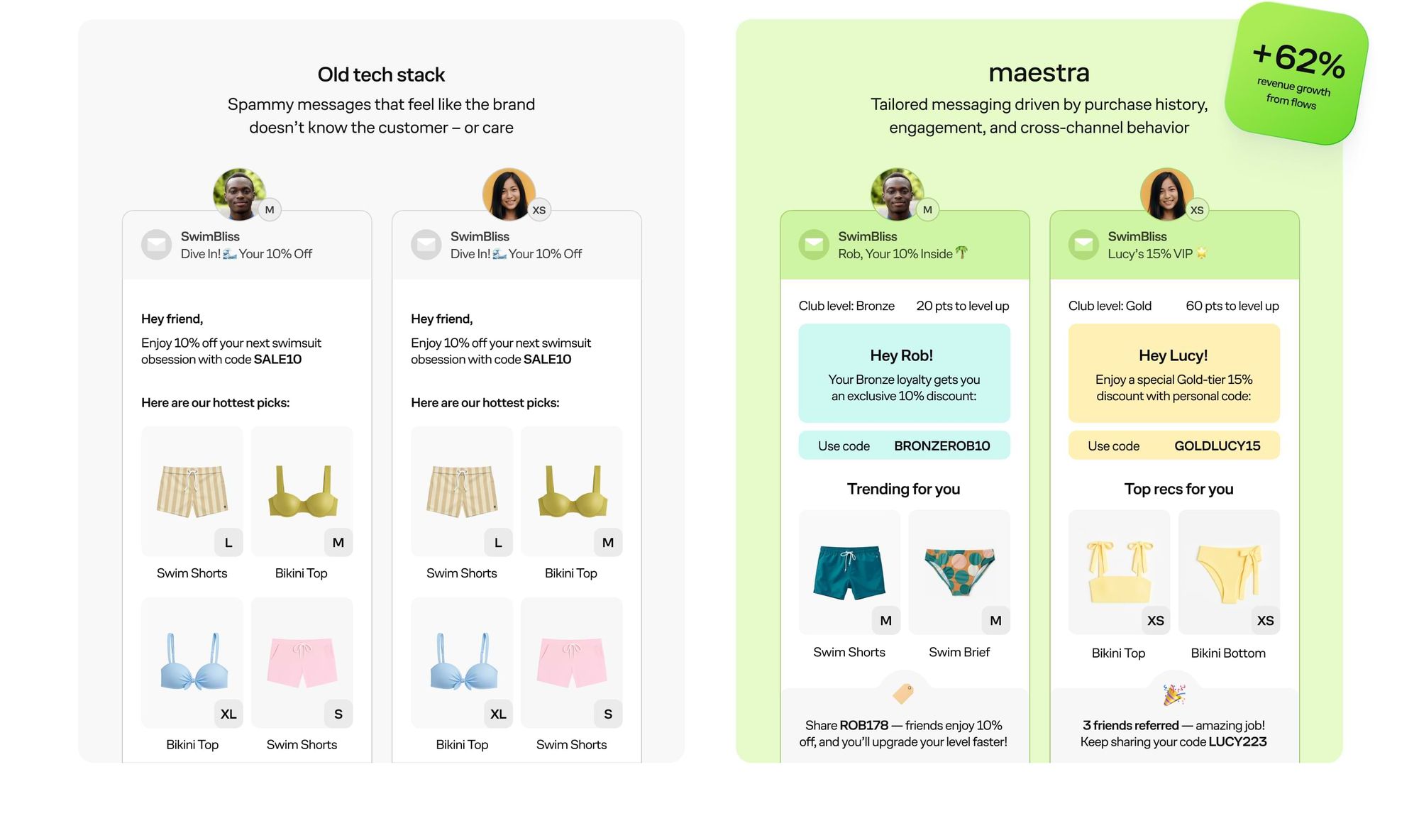
Maestra's ten modules all pull from the same commerce-specific data model, so recommendations, journeys, and loyalty logic all react to the same real-time customer profile. Under the hood, the platform runs at 2M RPM with under 300ms processing.
Your forward-deployed marketer
The difference between advice and implementation
An agency sends recommendations and an invoice. Your marketer opens the platform and builds the thing, which is why the improvements that are technically easy but always postponed actually ship.
Work delivered in the platform, not as a deck
The postponed improvements get shipped
No separate services fee
Replace your stack
Consolidation that customers actually notice
The clearest sign a consolidation worked is that nothing feels worse afterward. Brands moving their recommendations, loyalty, and messaging tools onto Maestra describe each function improving, not just merging, once it runs on shared, real-time data.
Have a look at the platform first
You do not have to decide anything to see how the pieces fit together. Start on the product pages and work back to your own stack.